
This article is taken from PN Review 292, Volume 53 Number 2, November - December 2026.
Pictures from the Rylands Library
‘Swift and Secret’: Exploring Phebe Byrom’s Shorthand
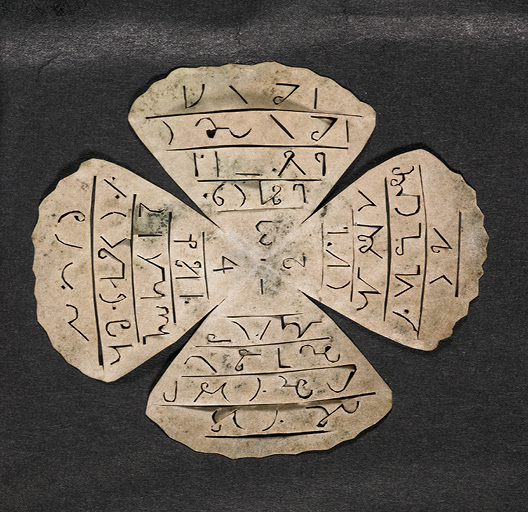
Shorthand verses designed for a watch case by Phebe Byrom, c.1727.
(Image provided by The John Rylands Research Institute and Library, The University of Manchester)
Writing presents us with a paradox. As scholars maintain, its purpose is to engender human to human communication, facilitate thought, and ensure the storage of information across time and space (Steven Fischer). Yet, it is compelled to do so through a blizzard of signs whose codes only those inducted in the arts of reading can break. The function of shorthand, writing’s corollary, is to strive ‘to be free of all redundancies unlike traditional orthographies’ (Hannah Boeddeker and Kelly Minot McCay). Used for centuries before the digital age to inscribe, transcribe and verify, it saved time, paper and ink and recorded speech for many textual communities across the globe. At the same time shorthand was a mode known only to a small group of initiates.
Flourishing in England with a particular ‘fervour’ (Tim Underhill) between the sixteenth and nineteenth centuries (Delphine Gardey), hundreds of shorthand manuals were produced outlining its myriad abbreviated systems of scriptualisation (alphabetic, proto-phonic and geometric), including those of the Manchester polymath and poet John Byrom (1692-1763).
A fellow of Trinity College, Cambridge and a member of the Royal Society, Byrom won acclaim as a Man of Letters. As a second son born into a well-to-do Lancastrian family, he was obliged to find a career, though he declined to take Holy Orders or to practice the medicine he’d trained for in France. Instead he chose to perfect and teach the schematic of shorthand he’d developed between 1715 and 1723. New Method of Shorthand first appeared in 1723, was updated in 1739 and recast as the Universal English Shorthand in 1767, published after his death. Prized as shorthand’s most authoritative system, it was taught at both Oxford and Cambridge and used by the clerk in the House of Lords for official business as well as recording debates verbatim.
Keeping tight control over the dissemination of his invention by charging his pupils an exorbitant five guineas a piece and swearing them to secrecy, Byrom also encouraged women and girls to learn the craft. The female members of his own family were adept short-handers, especially his sister Phebe (1697–1785). Although little is known about her, we are told she was crowned Grandmistress of Shorthand and even permitted to teach. Evidence of her virtuosity in the medium however survives in the enigmatic trace shown here. Measuring less than half-an-inch by half-an-inch, this fragile four-leaved scrap, known as a watch paper, once lived within the pocket watch of an unknown recipient as a ‘secret on the brink of articulation’ (Joanne Louise Appin). Carefully preserved, Phebe’s tiny, perfectly formed ciphers, arranged compactly in four verses, meditate upon the passing of time. And across time through this ‘poetics of hiding’ (Appin) she becomes legible and as we catch sight of her presence, we see her shine.
Could but our tempers
Move like this machine
Not urged by passion nor
Delayed by spleen
And true to
Nature’s regulating powers
By virtuous acts distinguish
Every hour.
Then health and joy
Would follow, as they ought
The laws of motion and the laws of
thought.
Sweet health to
Pass the present moments
O’er. And everlasting joy, when time
Shall be no more.
This article is taken from PN Review 292, Volume 53 Number 2, November - December 2026.